👋 Hey there. Each week I share one thing I’m actually doing to grow. This week is a big one: how I built a customer & prospect advisory board out of the data we already had, and why it told me things our real one never did.
Let’s talk about advisory boards.
The classic CAB looks like this: 10-12 of your happiest customers, a nice dinner twice a year, a slide deck about the roadmap. Everyone nods. Someone asks for SSO. You leave feeling great.
Here’s the problem. A traditional CAB only hears from people who already said yes and stayed. It’s survivorship bias with a catering budget. The voices that would teach you the most are never in the room:
The buyer who picked your competitor in the final round
The champion who loved you but couldn’t get budget approved
The admin who quietly churned after 9 months
The prospect who engaged with you but then disappeared
The thing is, those people have told you what they think. It’s sitting in your CRM’s closed-lost notes, in hundreds of hours of recorded sales calls, in online reviews of you and your competitors. Nobody has time to read it all.
AI does.
So over the past few months, I connected our AI to Salesforce/HubSpot, Gong and G2, and built what I call an AI advisory board: a standing panel of voices, each grounded in real records, that I can ask questions any day of the week. It now runs our win/loss analysis, tells us what we’re genuinely good and bad at, and pressure-tests positioning before we ship it.
Here’s exactly how to build one, prompts and templates included.
The idea: an advisory board with three voices
A real CAB gives you one voice: happy customers. An AI advisory board gives you three, and the two you’ve been missing are the most valuable.
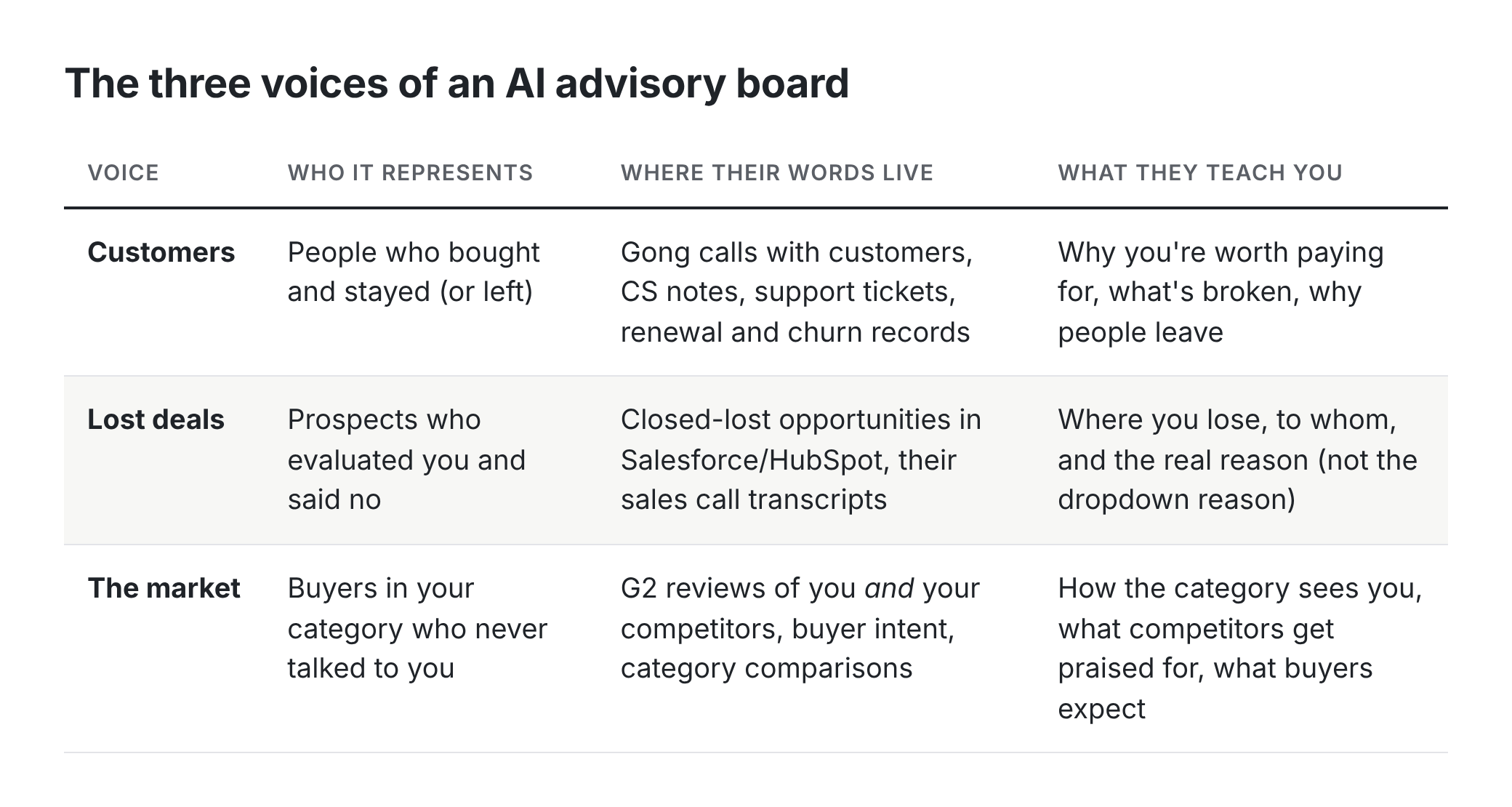
The important shift: you’re not asking AI to imagine what customers and prospect think. Every answer the board gives has to point back to real records: a call, a deal, a review. That’s what separates this from “ChatGPT, pretend you’re my customer” (which is mostly AI telling you what you want to hear).
Think of it as a board that never cancels, never gets polite, and includes the people who said no.
Step 1: Connect your AI to the data
A year ago this step meant CSV exports and a lot of copy-paste. Today most of these tools connect to AI assistants directly through MCP (Model Context Protocol), a standard way for AI to read data from your apps with your existing permissions. I use Claude; most of this works in other assistants that support MCP too.
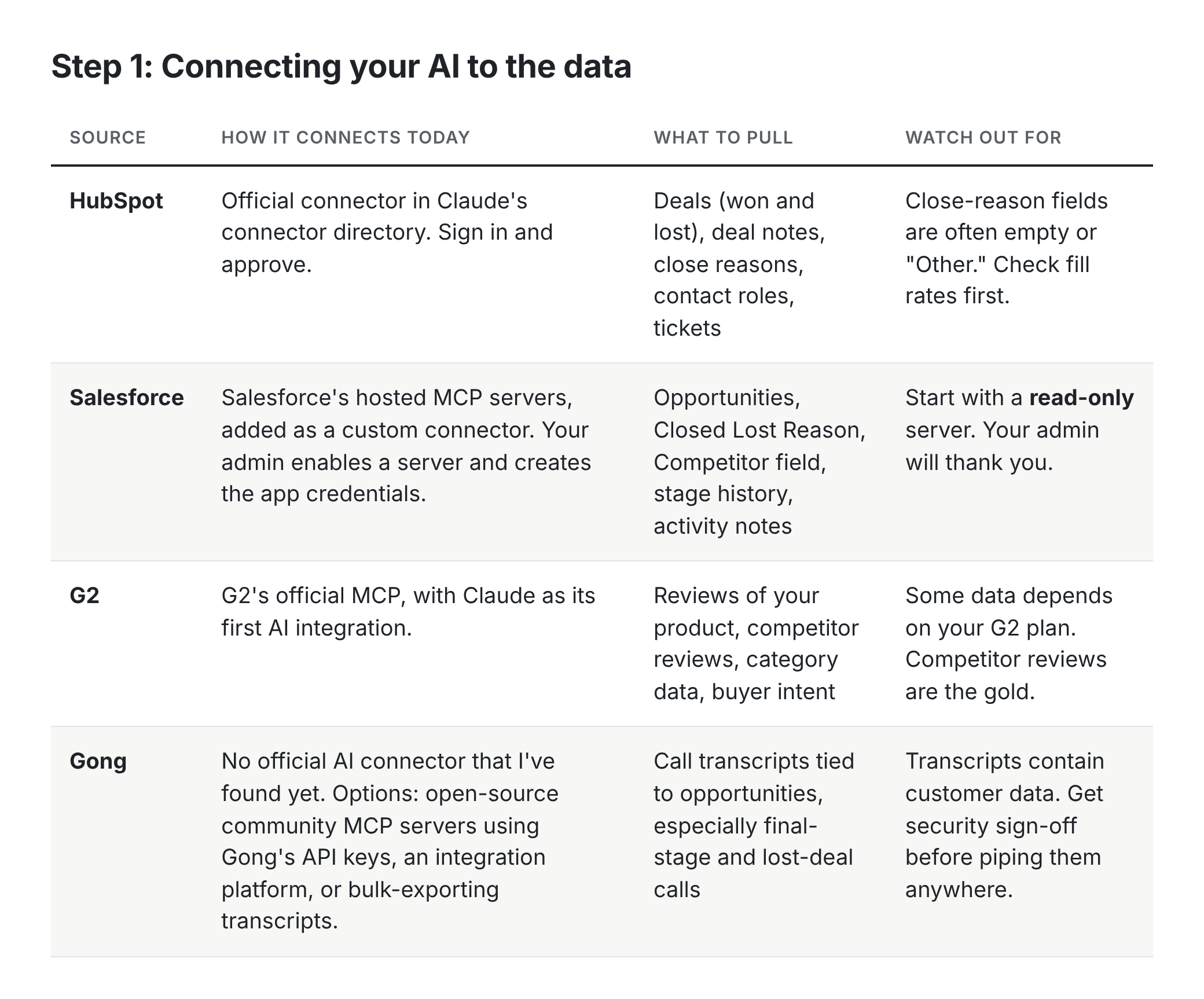
Before you connect anything: fix three fields
The AI is only as good as what it can join together. Before I ran a single analysis, I checked three things:
Calls are linked to opportunities. If Gong calls aren’t tied to deals in your CRM, the AI can’t tell you what was said in deals you lost.
Closed-lost reason and competitor are filled in. Pull a quick count. If over a third say “Other” or are blank, that’s fine; the transcripts will fill the gap. But you need to know.
Segment fields are clean. Company size, industry, plan. Otherwise every insight comes out as “customers say...” when the real answer is “mid-market fintech customers say...”
💡 Tip: Start small. One quarter of closed deals is plenty for the first run.
Step 2: Build the board’s seats
A board needs members. Each “seat” on my AI board is a data slice, not a made-up persona. The seat speaks only for the records inside its filter.
These are the six seats I started with:
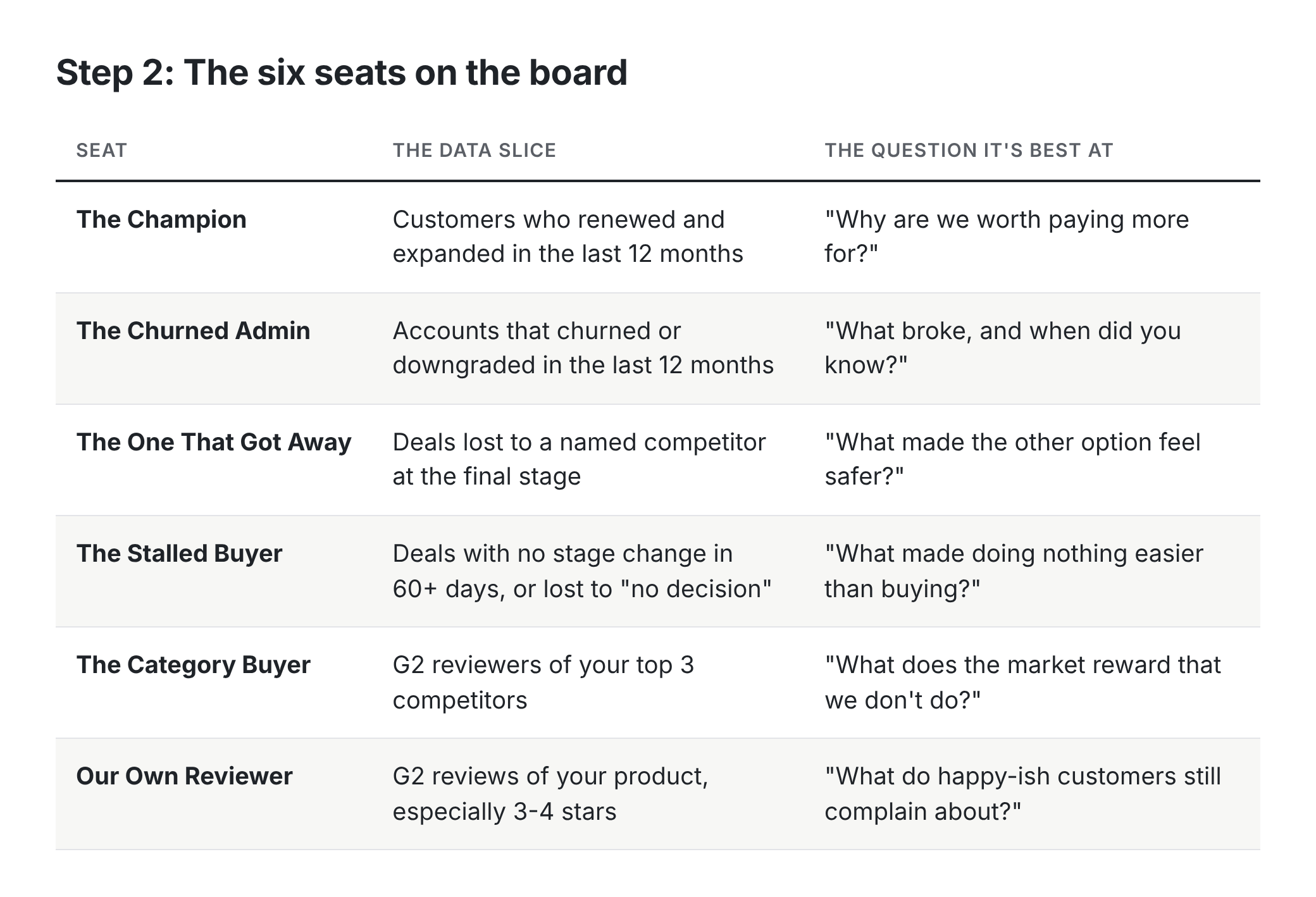
The first build prompt turns each slice into a seat card, a one-page brief the board uses every time it meets:
“For the seat ‘The One That Got Away’: pull every opportunity closed-lost to a named competitor in the last 2 quarters, with at least one call in the final stage. Read the deal notes and the transcripts of the last 2 calls in each deal. Build a seat card using the template below. Every claim must cite at least 2 records by opportunity name or call date. If the data doesn’t support a field, write ‘not enough evidence.’ Do not fill gaps with assumptions.”
The template:
# Seat: The One That Got Away
Records: 47 lost deals, 112 calls (Q2-Q3 2026)
Segments: 60% mid-market, 30% enterprise, 10% SMB

## What they were trying to solve
[In their words, 3-5 quotes with sources]

## What they valued most when choosing
[Ranked, with how often each came up]

## Where we fell short
[Ranked, with record counts]

## What the winner did better
[By competitor]

## What they believed about us that wasn't true
[Perception gaps, with quotes]

## Confidence
[High / medium / low, and why: sample size, data gaps]
The Records line and the Confidence section are what keep this honest. A seat built on 6 deals should sound much less sure of itself than one built on 60.
Step 3: Run a real win/loss analysis
This is where the board pays for itself. Traditional win/loss means hiring a firm to interview 15 buyers, a few months later. The AI version reads every deal from last quarter in an afternoon. It doesn’t replace buyer interviews (more on that below), but it tells you exactly which interviews to do.
Analysis 1: Stated reason vs. real reason
Your CRM’s closed-lost dropdown is what a rep picked at 6pm on the last day of the quarter. The calls are what actually happened. The gap between them is the most valuable thing in this whole email.
“For every deal closed-lost last quarter: compare the Closed Lost Reason in the CRM with what the call transcripts and deal notes show. Classify the real primary reason using evidence from the calls. Then build a table: stated reason, % of deals, and what the calls actually show for that group. Quote buyers where possible, and list the 3 deals that best illustrate each pattern.”
Here’s the shape of what comes back (illustrative numbers; yours will differ):
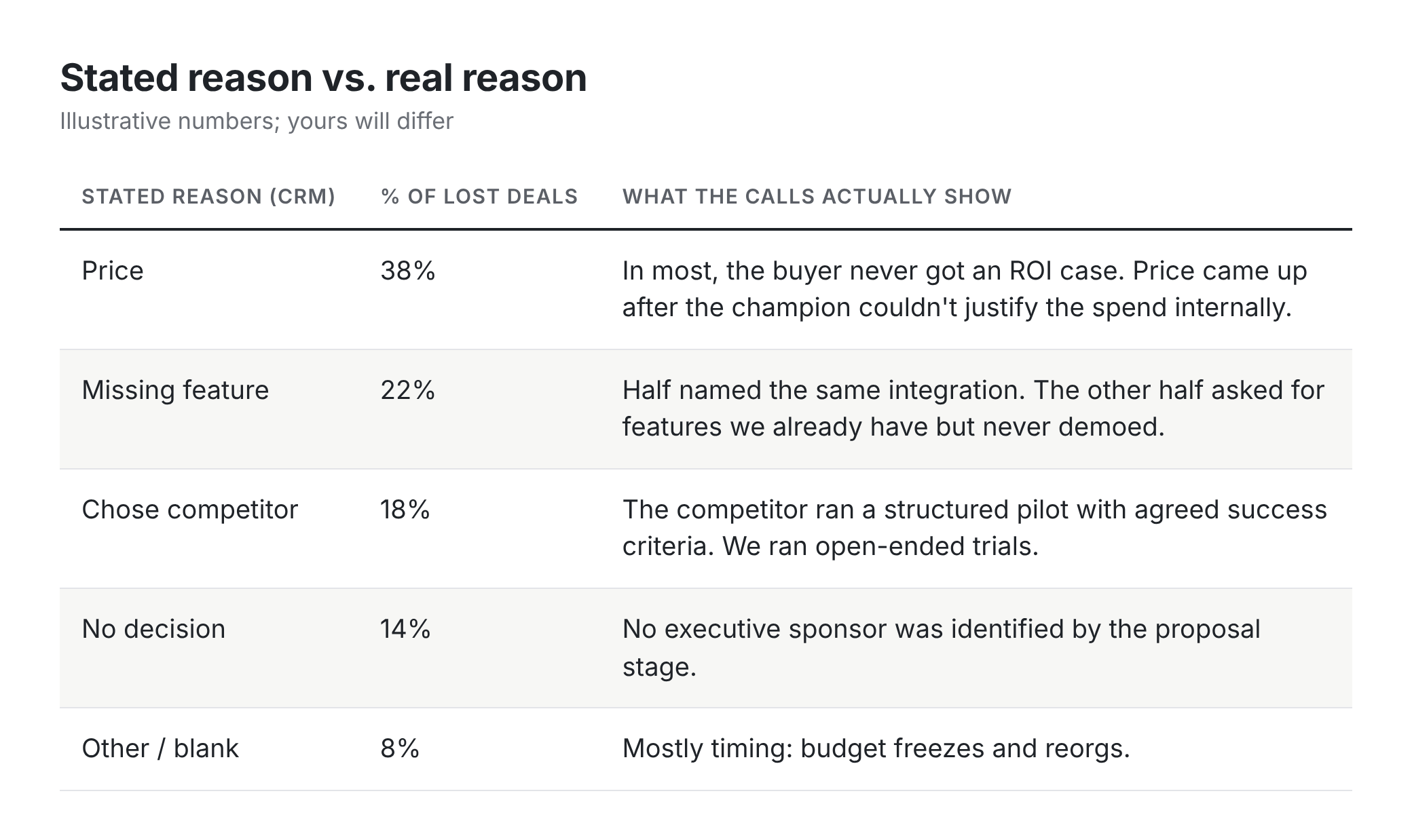
Read that table again. “Price” turned out to be a business case problem, which is a marketing and enablement fix, not a discounting one. That’s the kind of insight that changes what you build next quarter.
Analysis 2: Why we win
Teams skip this one, and it’s a mistake. Your wins tell you what to double down on in positioning.
“For every deal closed-won last quarter, find the moment in the calls where the buyer’s tone shifted from evaluating to convinced. What was said or shown just before? Group these moments into themes, rank them by frequency, and compare them to how our website and pitch deck describe our value.”
The last line matters. Often the reason people buy isn’t the thing your homepage leads with.
Analysis 3: Where in the funnel we lose
“Using stage history, show where lost deals stall or die, by segment and competitor. For the stage where we lose most, summarize what happens in the last call before the deal goes quiet.”
This tells you which asset is missing. A deal that dies after the security review needs a different fix than one that dies after the pricing call.
Step 4: What we do well, and what we don’t
Win/loss tells you about deals. This step tells you about the product and the experience, through the eyes of the market. G2 is the main input here, because it’s the one place you can read your competitors’ customers as easily as your own.
“Pull G2 reviews from the last 12 months for us and our top 3 competitors. Tag every ‘what I like’ and ‘what I dislike’ statement with a theme (onboarding, ease of use, support, integrations, reporting, pricing, reliability, and any others that emerge). For each theme, show what share of reviews praise it and what share complain about it, per product. Then sort the themes into 4 groups: strengths to defend, weaknesses that cost us deals, table stakes, and places we over-invest.”
The output is a scorecard like this (illustrative):
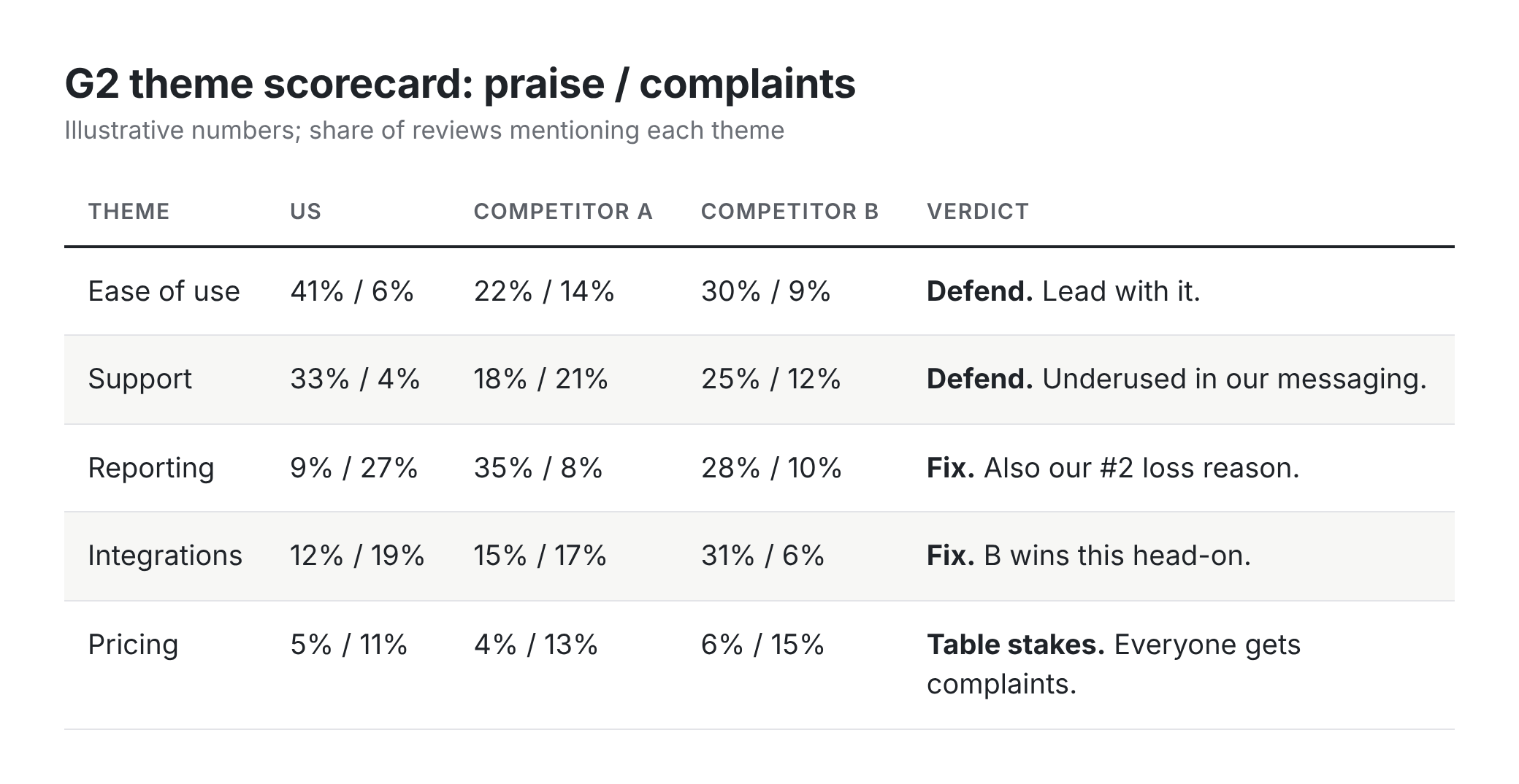
The magic happens when you cross-reference with Step 3. A weakness on G2 that also shows up in lost-deal calls is a priority. A weakness on G2 that never comes up in deals is noise, at least for now.
Two more prompts I run here:
“What do customers praise competitors for, in their own words, that no review of us ever mentions?” This is your blind-spot list.
“Find reviews from people who switched to us from a competitor, or away from us to one. What triggered the switch?” Switch stories are the closest thing to a free win/loss interview.
Step 5: Hold board meetings before big decisions
Steps 3 and 4 look backward. This is where the board becomes a product marketing advisory board you can convene any day. Before we ship new positioning, change pricing or launch something, I put it in front of all six seats.
The meeting prompt:
“Convene the advisory board. Here is what we’re considering: [new homepage headline / pricing change / launch plan]. Each seat responds separately, in 3-5 sentences, based ONLY on its seat card and records. For each seat: (1) how this lands, (2) the evidence (cite records), (3) what would make it land better, (4) confidence level. Then: where do seats disagree, and what’s the one question we’d need real customers to answer to settle it?”
Here’s an abbreviated example, testing a new headline: “The reporting platform finance teams actually trust.” (Illustrative.)
The Champion: Lands. “Trust” echoes renewal calls, where customers keep saying the numbers “finally match.” High confidence, 30+ calls.
The One That Got Away: Risky. Several lost buyers said our reporting was weaker than Competitor A’s. Leading with reporting invites the exact comparison we lose. Medium confidence.
The Category Buyer: “Trust” is generic. Every competitor’s reviews use it. What’s specific to us is speed of setup. High confidence.
Our Own Reviewer: Reporting is our #1 complaint on G2. Prospects who check reviews will feel the gap. High confidence.
Where seats disagree: Customers who stay love the accuracy; the market thinks our reporting is weak. The question to settle: is reporting genuinely weak, or just badly demoed? (Step 3 showed half of “missing feature” losses were features we have but never showed.)
That’s not a yes or no. It’s a much better question than the one I walked in with, in 10 minutes instead of 10 weeks.
Other meetings worth holding:
“We’re raising prices 15% on the Pro plan. Which seats churn, which don’t notice, and what do we say to each?”
“We want to move upmarket. Which seat’s data says we’re ready, and which says we’re not?”
“Here’s our launch email. Rewrite the first line for each seat, then tell me which version fits the most buyers.”
Step 6: Make it a monthly ritual
A one-time analysis is a slide nobody opens again. The value comes from the board meeting every month, so you can see what’s changing. Here’s the rhythm I run:
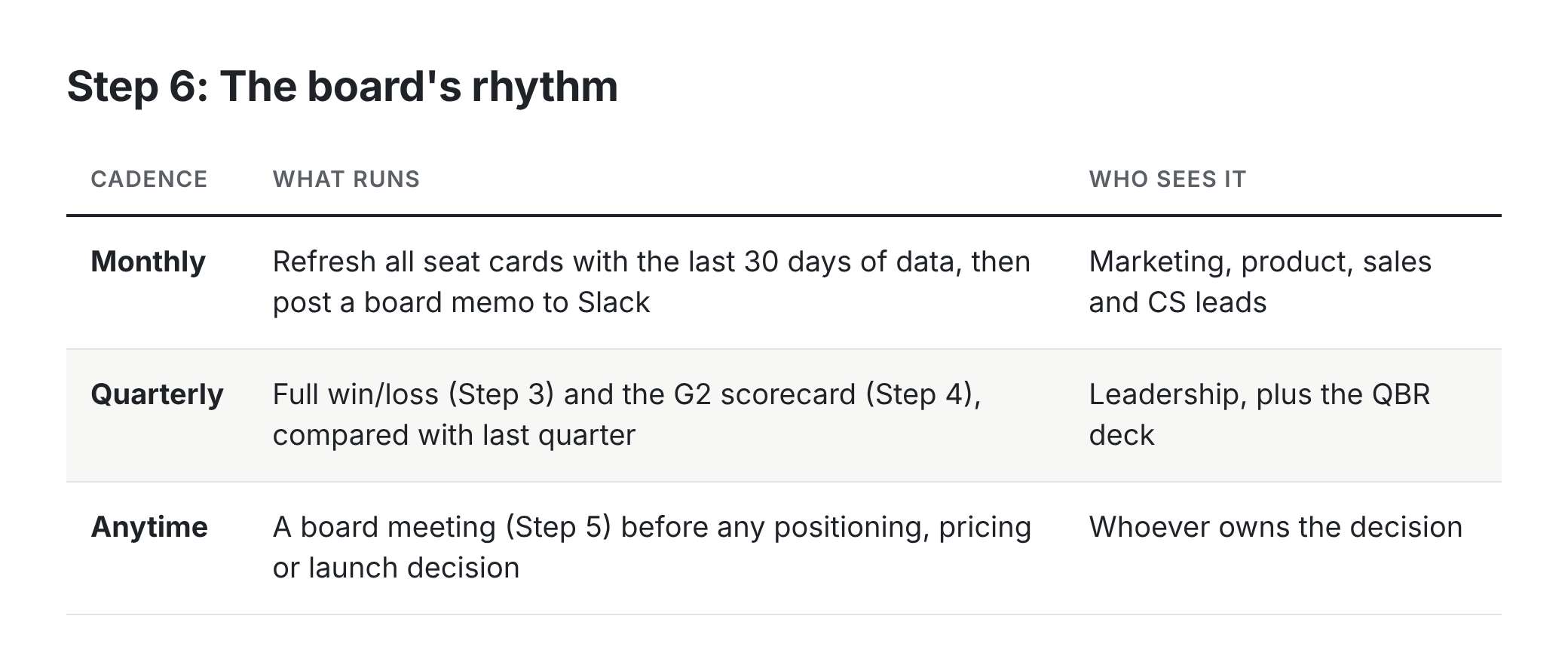
To avoid rebuilding this every time, I packaged the prompts, seat definitions and templates into a skill: a folder of instructions the AI follows whenever I ask for “the board.” A scheduled task then runs it on the first Monday of each month and posts the memo to a #customer-board Slack channel.
The memo format is deliberately short:
🪑 Advisory board memo: November 2026

WHAT CHANGED THIS MONTH
- "Reporting" complaints in lost deals: up from 4 to 9 deals
- New competitor showing up: [name], in 5 mid-market deals
- Champions keep praising: onboarding speed (12 calls)

THE ONE THING TO ACT ON
[One recommendation, the evidence, and who should own it]

OPEN QUESTION FOR REAL CUSTOMERS
[One question the data can't answer, for the next customer call]

Full seat cards: [link]
That last section is my favorite. Every month, the board hands the team one question to ask a real human. Which brings me to the most important part.
Where this breaks (read this part)
I’d be lying if I said this replaces talking to customers. It doesn’t. Here’s where it falls short:
The seats aren’t people. They summarize what people already said. Ask them about something truly new, like a product that doesn’t exist yet, and they’re extrapolating. Treat those answers as hypotheses.
Garbage in, garbage out. Unlinked calls and empty close-reason fields quietly skew everything. Fix the three fields from Step 1 first.
G2 is a loud minority. Reviewers skew toward strong opinions, and some reviews are incentivized. Use G2 for themes, not percentages you’d put in a board deck.
AI likes to agree with you. If you pitch your idea enthusiastically, the board leans yes. Write prompts neutrally, ask at least one seat to argue against you, and require citations.
Spot-check the citations. Every month I open 5 cited calls or deals at random to confirm they say what the AI claims. It’s 15 minutes, and it’s the reason I trust the rest.
Privacy is real. You’re piping customer conversations through AI. Get sign-off, use read-only access, and don’t put customer names in Slack memos that go company-wide.
The best use: building your real CAB
Here’s the twist. The AI board made our human advisory board much better.
It picked the members. Instead of inviting our 10 friendliest customers, we used the seat data to invite a mix: champions, a churned admin, two buyers who chose a competitor (people are surprisingly willing to explain why they said no), and two stalled buyers.
It wrote the pre-reads. Each member got a one-page summary of what the data says about people like them, and was asked: “Is this right?”
It set the agenda. We only discussed the open questions the AI board couldn’t answer.
Same dinner budget. Far better conversation.
Try it this week
Don’t build all six seats. Connect your CRM, pull last quarter’s lost deals and run Analysis 1: stated vs. real reason. It takes about an hour, and I’d bet the result surprises you.
If it does, hit reply and tell me what you found. I’ll share the best (anonymized) patterns in a future issue.
Thanks for reading, see you next week!
Idan.
Sources
How each tool connects to AI, checked November 2026: